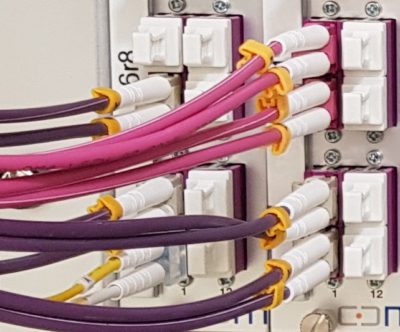
For anyone who has managed a data center fiber plant over the past decade, the arrival of 400 Gigabit Ethernet came with a painful side effect: singlemode fiber. If your DC was built in the era of 10G or 40/100G BiDi, chances are your structured cabling was entirely multimode, a perfectly reasonable choice at the time. Then, 400G arrived, and all the dominant transceiver options (DR4, FR4, LR4) required singlemode. Overnight, that existing multimode plant became a liability for anyone planning to upgrade.
That situation is now changing, thanks to a transceiver Cisco quietly added to its QSFP-DD portfolio in the last few months: the QDD-400G-BD.
A Brief History of Fiber in the DC
In the early days of 10 Gigabit Ethernet, multimode fiber was the standard for intra-DC connectivity. It was cheaper than singlemode, easier to handle, and the short-reach transceivers (SR variants) were significantly less expensive than their singlemode counterparts. 40G BiDi extended the useful life of existing OM3/OM4 infrastructure by running two wavelengths bidirectionally over a single duplex LC fiber pair: same connectors, same fibers, just an optical transceiver swap. Then, 100G BiDi followed the same principle, and the transition from 40G to 100G was painless for anyone already on duplex multimode: again, just swap the optics.
Then came 400G, and the BiDi story hit a wall. The transceivers that became mainstream at this speed — DR4 (MPO-12, 500m) or FR4 (duplex LC, 2km): all required singlemode fiber. For the first time, operators who had happily ridden the BiDi wave from 40G through 100G found their existing duplex LC multimode plant was simply incompatible with the new generation.
For data centers needing to upgrade to 400G, this meant pulling new singlemode fiber (trunks, patch panels, cassettes: the whole stack) to have a parallel singlemode infrastructure alongside existing multimode. Not a cheap operation! New fiber pulls in a live data center are disruptive and expensive.
What the QDD-400G-BD Actually Does
The QDD-400G-BD is a 400G QSFP-DD BiDi transceiver that operates over duplex multimode fiber with a standard LC connector. It is the 400G successor to the widely deployed 40/100G BiDi transceivers.
The technology behind it uses eight PAM4 lanes mapped to four optical wavelengths per fiber; the transceiver enables high-speed, cost-effective short-reach connectivity with duplex LC connectors. Each fiber carries four wavelengths simultaneously — two in each direction — at 850nm, 880nm, 910nm, and 940nm. This is short-wavelength division multiplexing (SWDM) applied to the multimode domain.

Image source: ciscolive.com, Mark Nowell & Errol Roberts: BRKOPT-2699
From the datasheet, the reach specifications are:
| Fiber Type | Max Reach |
|---|---|
| OM3 | 50m |
| OM4 | 70m |
| OM5 | 100m |
The connector is a standard duplex LC UPC — the same connector your existing multimode patch cords already use.
One note worth flagging for real-world deployments: the operating temperature range is 0°C to 65°C, slightly more restrictive than the 0–75°C range of other QSFP-DD modules in the portfolio. This is worth checking against your hot-aisle temperatures in dense deployments.
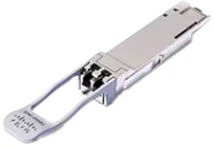
Image source: Cisco.com
The Upgrade Path: Why This Matters
Upgrading from 40G or 100G BiDi to 400G BiDi is seamless because all generations in Cisco’s BiDi optics family share the same duplex LC MMF infrastructure. This means: swap the transceivers, keep everything else. No new fiber trunks, no new MPO cassettes, no new patch panels, no re-labeling of ports.
The QDD-400G-BD is also backward compatible with the QSFP-100G-SR1.2, which is important for incremental upgrades. In a leaf-spine architecture, you can upgrade the spine to 400G switches with QDD-400G-BD transceivers, while leaf nodes that haven’t been replaced yet continue running QSFP-100G-SR1.2 at 100G — all over the same fiber plant.
Fiber Efficiency: BiDi vs. Parallel Optics
One aspect that doesn’t get enough attention is how BiDi compares to parallel optics in terms of fiber utilization. The alternatives for 400G over multimode are SR4.2 (MPO-12, four fiber pairs) and SR8 (MPO-16, eight fiber pairs). With trunk fiber bundles, this adds up quickly.
Cisco 400G BiDi provides 6.4 Tbps of total bandwidth using 16 fiber pairs (sixteen 400G links). In comparison, SR4.2 delivers 1.6 Tbps with only four 400G links, while SR8 offers just 800 Gbps with two 400G links. Put differently: for the same amount of fiber, BiDi delivers 4x more aggregate bandwidth than SR4.2 and 8x more than SR8. For high-density DC deployments, this is a significant consideration, both in terms of installation cost and physical space consumed by larger MPO bundles.
What This Costs You (vs. What It Saves)
The transceiver itself isn’t cheap, but it is notably more affordable than the other multimode 400G options in Cisco’s portfolio. The QDD-400G-SR4.2-BD and QDD-400G-SR8-S both carry a list price of ~$6200 USD, while the QDD-400G-BD comes in at ~$3500 USD price list. Roughly 45% less! As always with Cisco pricing, real prices and volume discounts will differ considerably, so treat these figures as relative indicators rather than absolutes.
The cost advantage of the BiDi approach therefore operates on two levels: the transceiver unit price itself, and the avoided infrastructure spend. If you were otherwise looking at a singlemode migration, that infrastructure delta includes:
- New fiber trunk cables, plus installation.
- New MPO patch panels and cassettes.
- Re-labeling, documentation, and change management overhead.
- Downtime risk during the migration.
For a mid-sized data center with a few hundred 400G ports, the cabling infrastructure savings alone can easily justify the transceiver choice, even before accounting for the lower unit price.
A Note on OM5
For new DC builds or partial re-cables, the QDD-400G-BD’s support for OM5 fiber at 100m reach is worth considering. OM5 (wideband multimode fiber, standardized under IEC 60793-2-10 type A1-OM5) is designed specifically for short-wavelength division multiplexing (SWDM) applications and is backward compatible with OM4 equipment. If you’re pulling new fiber anyway, choosing OM5 over OM4 gives you extra headroom.
Context in the Broader QSFP-DD Portfolio
It’s worth noting that the QDD-400G-BD is not the only multimode option in the Cisco 400G portfolio. The SR8-S (MPO-16, 100m OM4) and SR4.2-BD (MPO-12, 100m OM4) also support multimode fiber, but both require MPO connectors and additional fiber strands. The QDD-400G-BD is the only 400G option in this portfolio that delivers full 400G over a simple duplex LC fiber pair — the universal connector type found in virtually every existing multimode patch panel.
Conclusion
The QDD-400G-BD is not a revolutionary technology: BiDi optics have existed for years. But its arrival at the 400G speed tier closes a significant gap that forced many organizations to choose between expensive fiber re-cabling and delaying 400G adoption. For any data center sitting on an existing OM3 or OM4 multimode plant, this transceiver is a serious upgrade path worth evaluating. For new builds, it’s a strong argument for choosing multimode over singlemode for intra-DC cabling up to 100m, given the long-term flexibility it provides across multiple transceiver generations.
The BiDi family now spans 40G, 100G, and 400G over the same duplex LC infrastructure. That kind of investment protection is rare in networking.
Disclaimer: This article is based on Cisco’s published datasheet and product documentation. I have not personally tested the QDD-400G-BD in a production environment yet, but we are discussing it. As always, please verify the transceiver’s compatibility with your specific platform before deployment.
Read more
- Cisco 400-Gbps QDD BiDi Pluggable Transceiver At a Glance
- Cisco 400G QSFP-DD Cable and Transceiver Modules Data Sheet
- Cisco Optics-to-Device Compatibility Matrix